











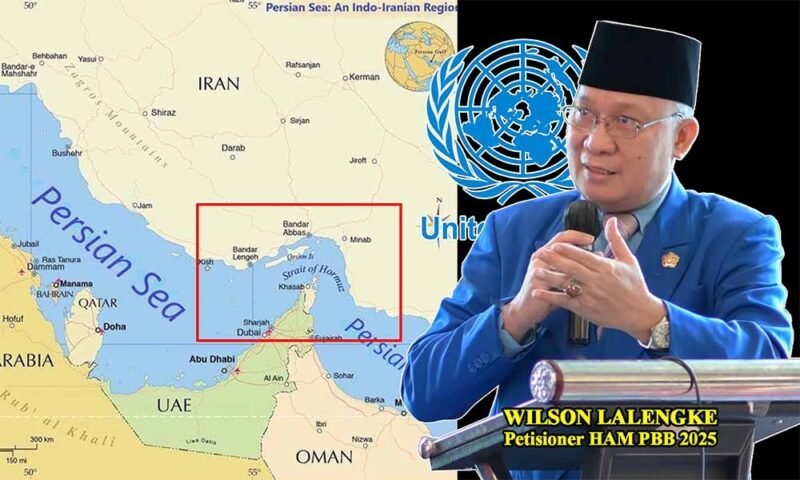
Detikdimensi.com Jakarta – The Strait of Hormuz is more than a geographic bottleneck. It is the jugular vein of the global energy market. Connecting the oil-rich Persian Gulf to the open waters of the Arabian Sea, this narrow passage carries roughly one-fifth of the world’s total oil consumption.
However, as geopolitical tensions simmer, the legal regime governing these waters – specifically Article 37 of the United Nations Convention on the Law of the Sea (UNCLOS) – faces unprecedented pressure. To maintain global stability, the international community must move beyond tactical interests and provide a unified, adequate respect for the “Transit Passage” regime.
ADVERTISEMENT

SCROLL TO RESUME CONTENT
Under UNCLOS, the Strait of Hormuz is classified as a “strait used for international navigation.” Article 37 establishes that in such straits, the regime of Transit Passage applies. Unlike the more restrictive “Innocent Passage,” transit passage grants ships and aircraft the right to cross the strait for the purpose of continuous and expeditious transit without the need for prior authorization from coastal states.
For countries like Iran and Oman, who border the strait, Article 37 represents a delicate balance between their territorial sovereignty and the world’s need for navigation. While coastal states have the right to regulate safety and prevent pollution, they do not have the legal authority to suspend or hamper transit passage. Respecting this rule is not merely a diplomatic courtesy; it is the cornerstone of the international maritime order.
*The Innocent Suffer: Wilson Lalengke’s Call for Justice*
The closure or prohibition of shipping in conflict-ridden straits often serves as a weapon of war. However, Wilson Lalengke, Chairperson of the Indonesian Citizen Journalists Association (PPWI), argues that this “weaponization” of geography is a crime against the global community.
“The world community – those billions of people in non-belligerent nations who are not involved in these regional wars – should not be made to suffer due to the closure of international straits,” Lalengke asserts, Thursday (26/03/2026). “When a strait is blocked, it is not just the opposing military that is hit; it is the worker in Asia, the family in Africa, and the industry in Europe that suffers from skyrocketing prices and resource scarcity. Shipping in conflict areas must be protected as a neutral, global utility,” he adds.
Lalengke’s view underscores a vital truth: in a hyper-connected world, no conflict is truly isolated. The prohibition of shipping in the Strait of Hormuz would constitute a “collective punishment” against humanity, violating the spirit of international cooperation that UNCLOS was designed to protect. The Strait of Hormuz must remain a corridor of peace, not a weapon of war.
*Philosophical Foundations: The Sea as a Common Good*
The legal arguments of UNCLOS find deep roots in the philosophy of Hugo Grotius, the father of international law. In his 1609 treatise Mare Liberum (The Free Sea), Grotius argued that the sea is a “common property of all” because it is limitless and cannot be occupied in the way land can. From this perspective, the Strait of Hormuz does not belong to the states that border it in an absolute sense; it is a shared resource held in trust for the benefit of all mankind.
Furthermore, Immanuel Kant’s philosophy of “Perpetual Peace” suggests that international law must be structured to facilitate “universal hospitality.” For Kant, the right of a stranger not to be treated with hostility upon arrival on foreign soil extends to the right of passage. To block a strait is to act with hostility toward the entire human community, breaking the “cosmopolitan right” that binds nations together.
In addition, John Rawls emphasized fairness and the protection of the least advantaged. In this context, neutral nations and civilian traders are the vulnerable parties whose rights must be upheld.
*The Path Forward: Adequate Respect for Law*
If nations continue to treat Article 37 as a “suggestion” rather than a mandate, the resulting anarchy will lead to the collapse of the maritime trade system. Countries must provide adequate respect for international law by:
1. De-politicizing Maritime Chokepoints: Recognizing that straits like Hormuz are neutral zones that must remain open regardless of land-based conflicts.
2. Multilateral Enforcement: Strengthening the role of the International Maritime Organization (IMO) to ensure safety standards are used for protection, not as a pretext for blockade.
3. Ratification and Adherence: Encouraging all states, including non-signatories, to recognize Transit Passage as Customary International Law.
The Strait of Hormuz is a test of our civilization’s maturity. Will we allow the “might makes right” mentality of the past to close the veins of our global economy, or will we uphold the visionary principles of UNCLOS?
Respect for UNCLOS is not optional; it is essential. The international community must demand compliance in which all parties must honour the right of transit passage. We also have to protect neutral shipping; naval forces should escort civilian vessels and prevent unlawful interference. Last but not least is strengthen legal mechanisms where the UN and International Tribunal for the Law of the Sea must be empowered to enforce rulings.
As Wilson Lalengke reminds us, the innocent citizens of the world deserve a guarantee that their livelihoods will not be held hostage by regional disputes. By respecting Article 37, nations do not just obey a treaty; they honour a moral obligation to the survival and prosperity of the human race.
(TIM/RED)